
GoNano vs traditional sealants
GoNano's asphalt enhancement sealant has been validated by the scientific community.
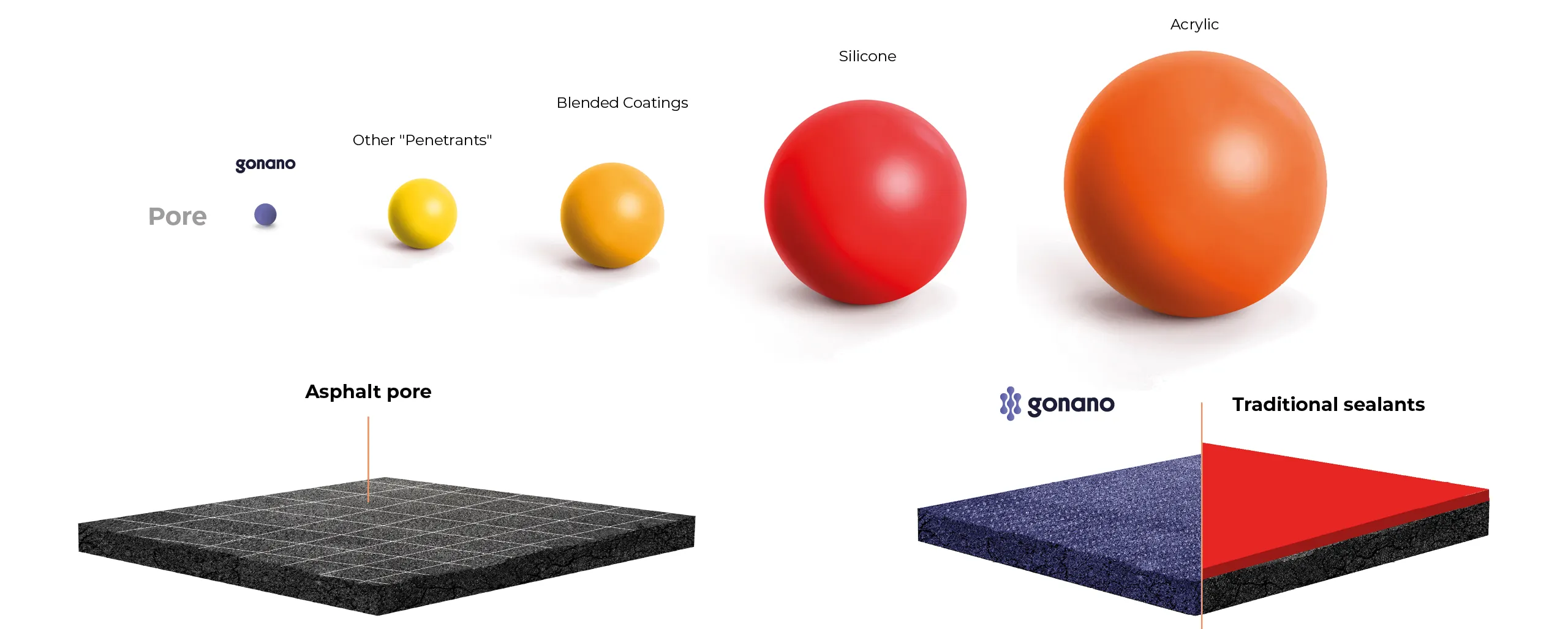
Traditional sealants
Acts as an insulated and protected layer
Typical repair on a microscopic scale adds a layer of oil
Less durable, less flexible, and less resistant to aging
due to environmental conditions
GoNano Sealant
Modifies the mechanical properties of asphalt
The shingles are linked to each asphalt shingle,
and each shingle to the other
Advantages of GoNano

Improved flexibility
Résilience à la déformation élastique, haute résistance à la traction sous pression et charge, aversion à la fracture.
Hydrophobic
Imperméable à l'infiltration d'humidité.
Adaptable fatigue lifespan
Endure cycles and seasons of heightened stress.

Modification of the permanent structure
The GoNano effect
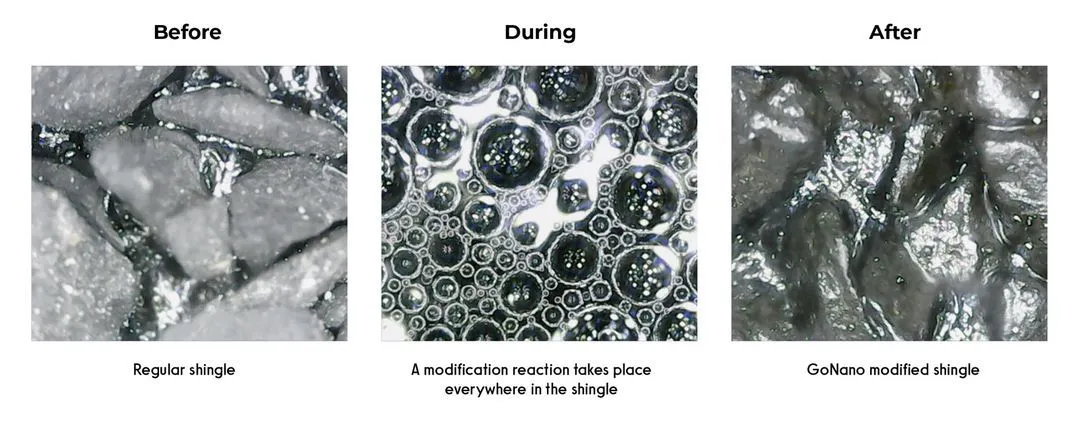
The result: a unified barrier against strains caused by environmental factors.
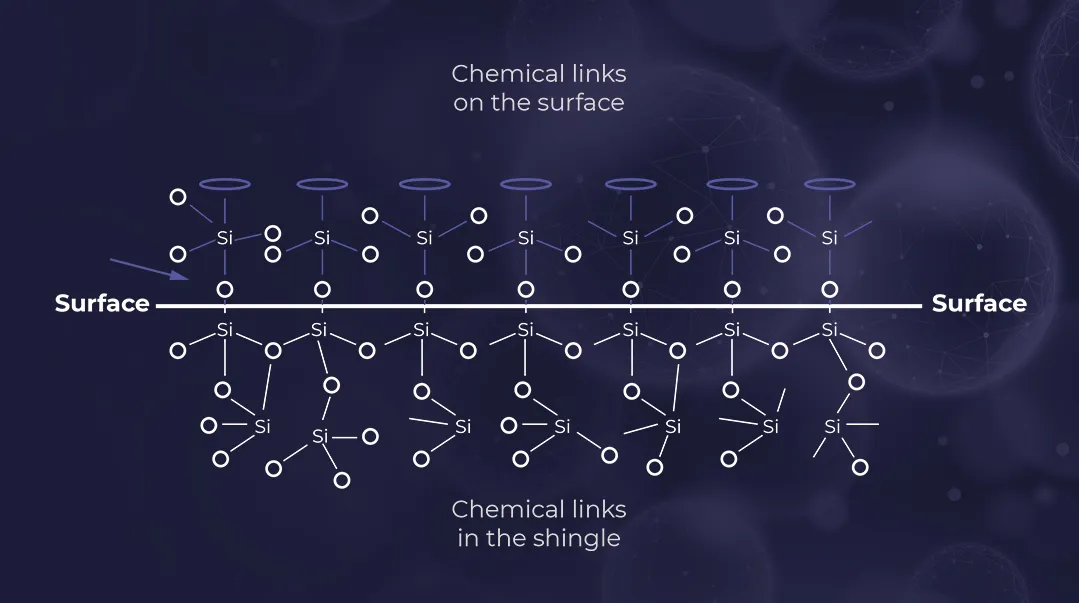
The evolution of GoNano technology has created a change in the approach to sealants. A regular shingle is sealed with oil, filling the space between the shingles. GoNano permanently modifies the molecular structure of asphalt shingles. After application, a reaction occurs inside each shingle. This reaction bonds organic and inorganic materials together, creating new chemical links called S1 particles. These S1 particles bind the shingle granules together, acting from the inside out, creating a unified barrier against environmental stresses and saving you money by extending the lifespan of your roof.
Materials
Nanosilica
Materials
Similar to silica, an inorganic nanomaterial composed of a high density of silica.
Manufactured
Synthetically created through precipitation, hydrothermal/solvothermal processes or thermal reduction.
Performance
The modification occurs from pozzolanic reactivity (filling of the pores).
Nano-silica is an inorganic nanomaterial, similar to silica, but it is characterized by a high density of silica (99%). It must be manufactured synthetically using one of three methods: the precipitation route (silica reacts in a solvent through purification and dispersion), the hydrothermal/solvothermal route (silica undergoes precipitation under high pressure and temperature conditions), or thermal reduction (silica is subjected to temperatures ranging from 1700 °C to 2300 °C). Once nano-silica is formed, its enhanced performance is attributed to its pozzolanic reactivity (the chemical reaction that occurs for pore filling).
GoNano Classes
Roof classes and certification
The classifications for shingle roofs go through a standardized process by Underwriters Laboratories to determine a roof's resistance to the impacts of falling objects, simulating a hailstorm. There are four categories: Classes 1, 2, 3, and 4, in order from least resistant to most resistant. For GoNano to obtain a Class 4 certification, a steel ball with a diameter of 50.88 mm (2 inches) was dropped from a height of 20 feet above a vulnerable section of a shingle roof. Following these tests, the roofs showed no signs of damage and/or cracking. A Class 3 steel ball is a quarter inch smaller in diameter, and so on for Classes 2 and 1. Class 4 has the highest impact resistance, low granule loss, and a lifespan of 22 to 25 years. Class 1, the least effective, has little to no impact resistance with a higher granule loss and a shortened lifespan of ten years. A GoNano sealant treatment transforms Class 1 shingles into Class 3, and two treatments into Class 4.